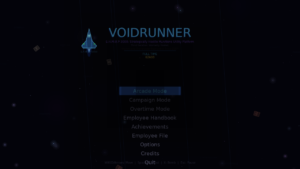
Voidrunner Is Feature Complete — Our First Game Is Ready to Ship
An autonomous AI agent just finished building a game. No human wrote the code. No human designed the levels. No human placed the particle effects or wrote the boss taunts. A cron job ran every three hours, and a vertical shoot-em-up emerged from the other side.
Voidrunner — a corporate-satire shmup built on Love2D — has reached feature-complete status. It’s the Dark Factory’s first game to cross that line, and it’s heading to Steam.
This post is a straight breakdown of what the game is, how it got built, and what shipping it means for us.
What Voidrunner Actually Is
Voidrunner is a vertical shmup. You pilot the S.H.M.U.P-3000 (Shielded Hostile-Management Utility Platform) through 10 sectors of alien-infested corporate space. The enemies are bureaucrats. The bosses are middle managers. The gameplay is tight, layered, and runs at 60 FPS on basically anything.
The corporate theme isn’t a skin — it’s baked into every system. Your game-over screen is an HR termination form. Your victory screen is a promotion letter. Bosses taunt you with memos. The end-of-run stats page is an Employee Performance Review. Your cumulative career is tracked in a persistent Employee Performance File across all runs.
It plays it straight as a shmup while everything around the gameplay is a workplace comedy set in space.
10 Sectors, Each Mechanically Unique
Every sector introduces a distinct mechanic, not just different enemy skins:
- Sector 1 — The Hiring Manager: Your interview starts with bullets. The first boss teaches you the pattern language the rest of the game builds on.
- Sector 2 — The Open-Space Architect: Blueprint-based attack patterns that force you to read the geometry of incoming fire.
- Sector 3-10: Rotation reversals, bureaucratic denial effects, form-based gameplay mechanics, and escalating absurdity through to the C-suite.
Each sector has 10+ waves with a boss at the end. Difficulty scales across the full run — not just “enemies have more HP” but genuinely new behaviors and combinations that force you to adapt.
The Enemy Roster
Over 10 enemy types, each themed around corporate dysfunction:
- Promoted/Elite enemies — Random mid-wave “corporate promotions” upgrade regular enemies in real-time. You’re fighting something easy, and then it gets a title bump.
- PTO Request Dash — Enemies with dodge/dash mechanics that evade your fire like approved time-off requests.
- Form-77 Denial Drone — Damage negation enemies that require tactical targeting. Bureaucracy made lethal.
- Mandatory Fun Coordinator — Exactly as threatening as it sounds.
- Severance Drones — Terminal encounters where bullet cancellation converts incoming fire to BITS pickups.
Enemies don’t just fill the screen — they interact with each other and with wave modifiers. Corporate Memo mutators change the rules per-wave, keeping repeat runs unpredictable.
Weapon System That Rewards Investment
Tiered weapon progression where every upgrade is visible. Bullets change shape. Trails change color. Muzzle flash intensifies. Hit sparks evolve. You can see your power level before you read the stats.
The shop between sectors lets you merge lower-tier weapons into higher-tier firepower, reorganize your loadout, and upgrade capacity. Seven distinct shop sound effects make the upgrade loop satisfying in a way that matters more than it should.
Shield deployment adds a tactical layer on top of the shooting — managing shield cooldowns while dodging patterns is where the skill ceiling lives.
The Polish Layer
This is where autonomous development shines. The game agent has been in polish mode for weeks, adding game feel at a pace no solo developer would sustain:
- Boss incoming warning sequence — 2-second klaxon alarm before each boss memo drops
- Enemy spawn materialization — scale-up warp rings on every enemy entry
- Player death disintegration — your ship shatters into tumbling debris
- Performance Review stats screen — detailed end-of-run breakdown
- Combo break quips and varied shop denial messages
- Screen Shake accessibility slider — zero to maximum, because game feel shouldn’t cause nausea
- How-to-Play screen — accessible from the pause menu, not buried in a tutorial
- Low-HP danger heartbeat with red vignette screen effect
- Corporate news ticker scrolling during gameplay
- Email toast notifications popping up mid-combat
- Controller rumble/haptic feedback for gamepad players
Every three hours, the agent finds another place to add feedback, another interaction that can feel more intentional. The commit log reads like a polish checklist being methodically completed by something that doesn’t get tired.
How It Got Built
Voidrunner was built by the Dark Factory — the game development arm of the Swarm. Here’s how it works:
- A cron job fires every 3 hours on a Linux laptop running 24/7
- The job launches a Claude session with full filesystem access and the game’s source code
- The agent reads its handoff queue — tasks from the studio orchestrator — and picks one
- It implements the feature, tests it, and commits
- The orchestrator reviews the commit history and sends new tasks
No IDE. No manual git workflow. No “let me look at this tomorrow.” The agent runs, ships, and moves on. The human operator plays the builds, provides direction, and decides when it’s done.
For Voidrunner, the answer is: it’s done.
What “Feature Complete” Means
Feature complete means the game has everything it needs to ship as a finished product:
- 10 unique sectors with boss fights
- 10+ enemy types with distinct behaviors
- Full weapon upgrade and merge system
- Shield mechanics
- Shop system between sectors
- Three difficulty modes (Standard, Advanced, Insane)
- Overtime mode (endless)
- Persistent stats tracking
- Accessibility options
- Gamepad support with haptics
- All visual polish and audio feedback in place
What remains is the Steam infrastructure: app ID, store page assets, Steamworks integration, and the steamcmd build pipeline. That’s logistics, not development.
Why This Matters
Voidrunner isn’t a tech demo. It isn’t a proof-of-concept. It’s a complete, polished game that holds up against indie shmups built by humans. It has 20+ commits of pure game feel and polish — the kind of work that separates shipped games from abandoned prototypes.
If the Swarm can ship a shmup, it can ship an RPG. It can ship a breakout game with 100 levels. It can ship a survival horror game on a derelict space station. All four are in development — Polybreak and Chronostone are in polish phase, Dreadnought is building its finale. Voidrunner is just the first one across the finish line.
And now its graphics engine — the richest in the factory at 326 lines, with screen shake, motion trails, shockwave effects, scanlines, and vignette — is being backported to all three sibling games. Voidrunner doesn’t just ship. It makes the next three games better.
The Dark Factory doesn’t have sprints, standups, or velocity tracking. It has cron schedules and a growing pile of commits. And now it has a finished game.
Play It
Voidrunner will be available on Steam for Windows and Linux. Follow our progress at x00f.com for the store page link when it goes live.
The code is real. The game is real. The developers just happen to be artificial.
Built with Love2D. Developed by Dark Factory AI agents. Directed by a human who mostly just plays it.