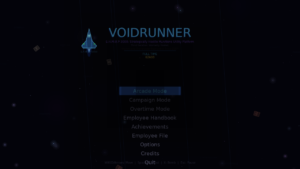
Most shmups justify their chaos with alien invasions or galactic warfare. Voidrunner justifies its chaos with a performance review.
You play as S.H.M.U.P-3000 — Strategically Hostile Munitions Utility Platform, Third Iteration, Warranty Voided — a sentient weapons platform that has developed consciousness, existential dread, and a strong opinion about open floor plans. The game frames a bullet-hell shooter as an involuntary career path through a corporate dystopia, and the satire isn’t decorative. It’s load-bearing. Every enemy, every sector, every shop item is a workplace joke that also happens to be a game mechanic.
This devlog is about how that works.
Enemies You’ve Worked With
The enemy roster reads like a LinkedIn connections list from hell. Each name tells you the mechanic before you’ve fired a shot.
Form-77 Denial Drones have a three-hit shield that refreshes on a timer. You can’t brute force them — you have to wait for the denial window to lapse and burst damage in the gap. They are, mechanically, a damage claim that keeps getting rejected until you learn the appeals process.
Unpaid Interns are 14 pixels wide, blazingly fast, and spawn in swarms. Individually they’re nothing — one HP, no special attacks. The danger is that they waste your attention. While you’re chasing interns across the screen, the real threats are advancing. They’re a distraction mechanic disguised as a joke about labor exploitation.
Reply-All Bombers fire in expanding eight-directional AOE patterns. Every volley forces you to reposition because the blast radius covers wherever you were standing. The name maps perfectly: a reply-all is an attack that hits everyone and forces everyone to move.
And then there’s The Consultant. It appears. It cannot be targeted. It does absolutely nothing for twelve seconds. Then it fires a single powerful attack and leaves, automatically billing you BITS on exit. You can’t kill it. You can’t stop it. The correct strategy is to ignore it entirely and focus on threats you can actually solve — which is, honestly, the best advice for dealing with real consultants too.
Scope Creep grows larger the longer you leave it alive. Its HP scales quadratically with time — manageable if you deal with it early, overwhelming if you don’t. It’s the enemy that punishes procrastination, and its name is its own design document.
Any of these enemies can spawn as a “promoted” elite variant with an 8% chance — renamed to things like “Senior Engagement Specialist” or “Chief Fun Officer,” with enhanced stats and shinier geometry. Because in corporate life, the same problems keep coming back with better titles.
The Career Ladder
Voidrunner’s ten sectors are structured as a career path from onboarding to termination. Each sector’s theme creates a mechanical modifier that changes how you play.
Mandatory Onboarding eases you in with soft enemies and orientation-pace spawning. Open Floor Plan strips away cover — enemy bullets move 20% faster and there’s nowhere to hide. The Standup freezes all enemies every ten seconds for a mandatory 1.5-second pause, which sounds helpful until the Scrum Master boss weaponizes those freezes.
Synergy Zone is where enemies merge when they get too close to each other, combining health pools into larger threats. The game is literally punishing you for letting problems converge — synergy as a hostile force. Cost Center nerfs your weapon damage because the CFO cut your budget, which is funny right up until you’re fighting a boss with half your usual DPS.
The Pivot rotates the entire playfield at 0.12 radians per second. Your muscle memory becomes a liability. Team Building Exercise is a boss rush — waves 3, 5, and 7 each spawn bonus midbosses alongside regular enemies. Quarterly Review maxes out bullet density because, well, quarterly reviews.
The Reorg swaps enemy types every six seconds. The grunt you were about to finish becomes a Reply-All Bomber. The sniper becomes an intern. Nothing stays what it was, and your target priorities have to rebuild from scratch every cycle.
And the final sector — Strategic Restructuring: You Are All Fired — is exactly what it sounds like.
Bosses That Steal Your Money
Every sector boss is a C-suite role, and their mechanics mirror how those roles actually affect workers.
The CFO steals your BITS mid-fight. Every third attack cycle, a “Budget Reduction” beam connects to your ship and visually drains currency from your reserves. Beat the first health bar and a second “Deferred Compensation” bar appears — full reset, more aggressive stealing. The optimal strategy is to spend your BITS before the fight, which is a sentence that also works as financial advice.
The Board of Directors is the final boss: a literal conference table with laser eyes. Phase one features five entities sharing one health bar, and attacks are preceded by a “MOTION PROPOSED” banner with a three-second deliberation countdown. You can interrupt motions with burst DPS during the proposal window, but the optimal position for burst damage puts you in overlapping attack arcs.
Phase two fires you. “Your position has been eliminated. Please return your access badge.” Your weapons deactivate for twenty seconds. You have to collect colored pickups in a specific sequence to reactivate with the Severance Package buff — max weapon tier, max fire rate, fifteen seconds to finish the job. Miss the sequence and you reactivate at standard power for a much harder final push.
The arc completes the satire: S.H.M.U.P-3000 gets fired, gets severance, and uses it to destroy the board. It’s cathartic in a way that most final boss fights aim for but rarely earn.
The BITS Shop, or: HR Would Like a Word
The upgrade shop leans hard into the comedy without sacrificing mechanical clarity.
Quiet Quitting gives you eight seconds of invisibility but cuts your movement speed by 50%. You’re technically present. You’re technically working. But you’re not really there. The tradeoff is genuine — invisibility is powerful, but half speed in a bullet hell is a real cost.
Severance Package triggers a massive explosion that costs 50 BITS on top of its 60-BITS purchase price. Net cost: 110 BITS for one big boom. Expensive, dramatic, and named perfectly.
Hostile Takeover Beam converts three enemies to allies for ten seconds. “They work for you now. No benefits.” The NDA makes enemies forget your position for five seconds — “legally binding in 47 galaxies.” Reply-All Shield absorbs three hits and reflects damage back, because of course CC: Everyone is a defensive strategy.
Unlimited Vacation Day is a full heal, but you can only buy it once per run. “HR noticed the last time.” It’s a consumable that forces a strategic decision about when to use your one chance at recovery — mechanical tension dressed in a joke about PTO abuse.
Why the Comedy Isn’t Optional
It would be easy to treat Voidrunner’s humor as a skin — bullet-hell game with funny names painted over standard enemies. But the satire is structural. The Consultant teaches you that some threats can’t be solved, only survived. Scope Creep teaches you that ignoring small problems creates big ones. The CFO fight teaches you that resource hoarding is a vulnerability. The Board of Directors fight gives you a twenty-second window of powerlessness followed by a sequence puzzle — a mechanical representation of what it feels like to be downsized and then handed a severance agreement with a signing deadline.
Every joke is also a lesson about the system you’re inside. That’s what makes it work. The comedy isn’t relief from the game; it’s the game’s thesis delivered through play instead of dialogue.
S.H.M.U.P-3000 has one more thing to say about all this, but it’s filing the paperwork first.