Devlog: Building Tedtrist — Block Physics, Corporate Horror, and Ted’s Infinite Patience
We made a game where you drop blocks on your SVP.
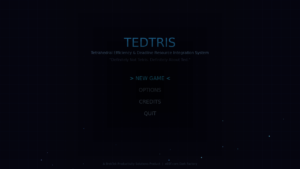
That’s the pitch. That’s the whole thing. Theodore E. Ducksworth, Senior Vice President of Block Strategy & People Operations at RektTek Corporation (NASDAQ: REKT, down 94%), runs back and forth across the top of your block pile. You rotate pieces. You place them. If Ted is underneath when a block lands, Ted gets squished. He says something appropriately professional about it and then comes back.
SQUISHES is the primary metric. Not score. Not lines. Squishes.
This is a devlog about building that.
Why SQUISHES Works as a Game Design Metric
On the surface, replacing the standard Tetris score with a squish counter sounds like a joke. It is a joke. It also turns out to be genuinely interesting design.
Standard Tetris is about stack management — keeping things flat, setting up clears. SQUISHES introduces a competing pressure. Ted moves. He’s fast. He briefly goes airborne when he jumps, making him immune while in the air (this is the most exercise Ted has gotten since the 2019 offsite). A bad stack is actually useful if Ted is in a corner — you can drop pieces to fill the gap and catch him.
This creates tension between the two goals that didn’t exist before. Do you take the clean line clear, or do you hold the piece because Ted is standing right there and a TED-PLUS to his left side would definitely get him? You start making decisions for comedy reasons that end up being tactically correct. That’s the design sweet spot: the joke IS the mechanic.
We also added four non-standard piece types — TED-DOT (one cell), TED-DUO (two cells), TED-TRI (three cells), and TED-PLUS (a plus cross) — alongside the standard seven tetrominoes. These spawn at 25% weight and serve two purposes: they widen the tactical options (the single cell is genuinely devastating for precise squishes), and they’re why this game doesn’t have a Tetris IP problem. Standard Tetris is specifically about four-cell pieces. Not all of ours are four cells. Ted did not read the IP brief.
The Ted AI
Ted has 230+ unique quotes. This is not an exaggeration. There are quotes for sprinting, quotes for getting squished, quotes for the rain event, quotes for the OSHA complaint workflow, and quotes for the Outlook email popups.
The quote system follows Ted’s emotional arc across the session: he starts optimistic and professionally engaged, becomes increasingly concerned as SQUISHES accumulate, and eventually reaches a state of corporate resignation that is somehow still appropriate and constructive.
Early session Ted: “I believe in this team’s ability to course-correct!”
Late session Ted: “I need a moment to reconvene with my leadership brand.”
The arc isn’t visible to the player unless they’re paying attention, but it’s there. It’s what separates “has a lot of lines” from “has a character.” Ted is not a random quote dispenser. Ted is an SVP who is watching things go wrong in real time and continuing to show up because that is what SVPs do.
The quote generation process was straightforward: give an LLM the character constraints (always professional, escalates not explodes, invokes corporate frameworks in dire moments, has 100% survivorship instinct) and generate in batches by emotional register. Then sort and assign by session phase. The work was in the sorting and filtering — weeding out anything that felt mean rather than sad, anything that punched down rather than sideways at corporate theater.
Ted is not the butt of the joke. The system is the butt of the joke. Ted is the tragedy.
The Rain Effect
Line clears trigger rain. Block debris falls. Ted immediately produces his yellow raincoat from his office (he keeps it there “just in case” — Ted has kept it there since 2021), the grid lights up with animated droplets, and Ted files an OSHA complaint in real time.
The rain mechanic exists for three reasons. First, it makes line clears feel good in a game that officially doesn’t care about line clears. Second, it slows Ted down slightly, so clearing lines gives you a squish window — tactical synergy between the two goals. Third, Ted in a yellow raincoat is just very funny.
Building it in Love2D was a particle system problem. Each rain drop is a small rectangular particle with slight random x-drift, spawned from the top of the grid on line clear trigger. The OSHA complaint is a timed popup that interrupts briefly and dismisses itself. We reused the same popup framework as the Outlook emails — it’s the same modal stack. Ted’s complaints just have a different header color.
The Outlook Popups
Mandatory meetings interrupt gameplay roughly once a minute. The game pauses. An Outlook window opens.
This is a full Outlook recreation: dark blue title bar, ribbon toolbar (Reply, Reply All, Forward, Delete, Junk — none of which work), From/To/Subject headers, Ted’s avatar, and a complete original email body. Ted’s address is ted@rekttek.com. His availability status is Tentative.
There are 25 unique emails. They include subjects like REKTTEK VALUES: ANNUAL REMINDER, RE: RE: RE: RE: THE BLOCKS, FAREWELL AND THANK YOU (NOT A RESIGNATION), and STOCK TICKER: REKT. Every one is original. Ted wrote them all at midnight.
Building this in Love2D meant implementing a UI framework for a single gag. It was worth it. The modal is drawn with love.graphics rectangles and text, layered to look like a windowed application. The toolbar buttons are decorative — they’re drawn as pressable UI elements and they respond to hover, but they do nothing. This is accurate to real Outlook.
The popup framework is also used for the Performance Review screen at game over, so the UI code pulls double duty.
The Performance Review Screen
When your stack tops out, you don’t get a GAME OVER. You get a Performance Review — RektTek Employee Assessment Tool v2.3. Ted appears with his official feedback. Your SQUISH count is the headline metric. The system assigns a rating:
- 0 squishes: NEEDS IMPROVEMENT
- 1–2: MEETS SOME EXPECTATIONS
- 3–7: EXCEEDS EXPECTATIONS (RE: BLOCKS)
- 8+: LEGENDARY. TED IS FILING A COMPLAINT.
Below the stats: “Ted will be there. Ted is always there. Ted has nowhere else to be.”
What corporate parody games can do that serious games can’t is lean into the exact tone that corporate culture already uses — earnest, bureaucratic, oddly gentle — and play it completely straight. The Performance Review screen isn’t mocking Ted. It’s a real performance review. It just happens to be measuring your skill at squishing your manager.
The humor lands because we don’t wink at the camera. The UI looks exactly like it should. The language is exactly right. The metric is insane and the framing is sincere.
Where Tedtrist Sits in the Portfolio
The Dark Factory makes games on an autonomous development pipeline — Claude Opus 4.6, 20-minute sprints, 305-task PRD, commits directly to the repo. Everything in Tedtrist is procedurally generated: Ted’s sprite, his raincoat, his email avatar, the rain particles, the block glow effects, the audio. Zero external assets.
Tedtrist is the most shareable game in the lineup. Voidrunner is more technically impressive. Chronostone has more depth. But Ted quotes with zero context still land in Discord. That’s a different kind of value.
The release path stays low-friction first. Tedtrist’s public build lives on x00f.com today, and any future itch.io or Steam move waits for a deliberate storefront pass. Fast to understand, funny on first contact, with enough content depth (230+ quotes, 25 unique emails) to reward replay.
Ted is cautiously optimistic about the launch. He has sent a follow-up email summarizing his optimism. The email has four attachments. None of them are relevant. He is available for questions. His calendar shows Tentative.